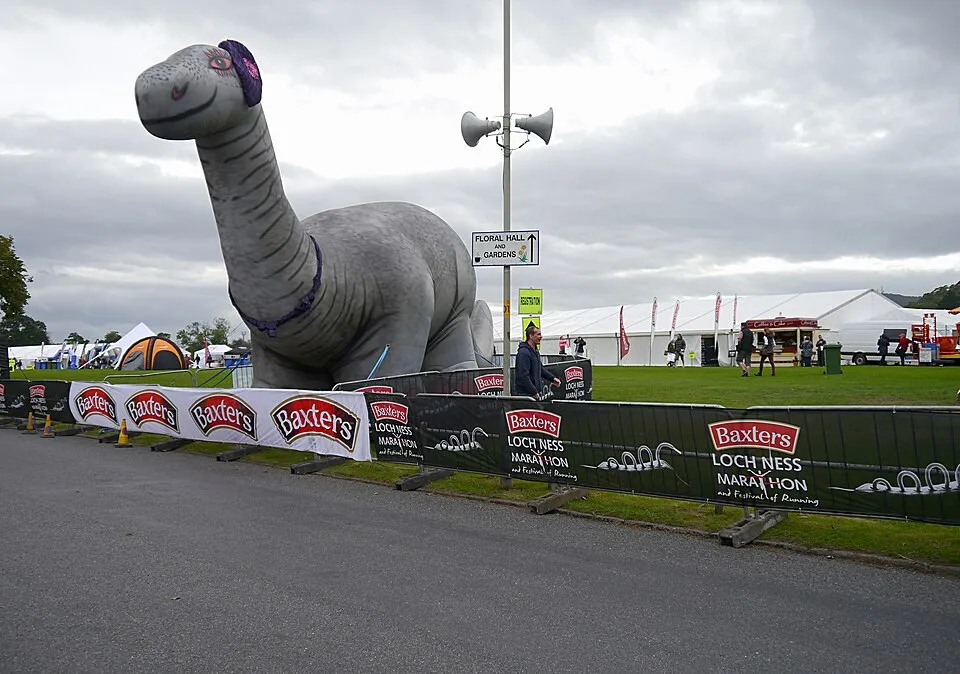
Loch Ness Marathon
Inverness, United Kingdom · Monday 27 September 2027
The marathon begins in an exposed moorland area, where runners must be prepared for unpredictable Highland weather and potentially cold conditions before the race begins. The initial section of the course trends predominantly downhill for the first six to seven miles, though there are minor climbs, including a particularly steep section after about 4.5 miles that challenges early pacing and leg control.
Difficulty Calculator
h
:m
:s
Adjusted Time
4:08:35
Time difference: +8.6 minutes compared to a flat, road, temperate course.
Course Details
Elevation Gain208m
Elevation High308m
Elevation Low7m
Weather Forecast
High29°C
Low14°C
Chance of Rain2%
How hard is Loch Ness Marathon?
Difficultharder than 67% of marathons
Flattest / easiestHardest
On our difficulty model, Loch Ness Marathon plays about 13 minutes slower than an average road marathon for a 3:30 runner. It ranks #377 hardest of 1151 marathons we analyse, and #23 of 57 in United Kingdom. Use the calculator above to see the exact adjusted time for your own goal pace.
What will you run at Loch Ness Marathon?
Estimated finish times on this course versus the same effort on an average road marathon, based on its elevation, surface, and expected race-day temperature.
| Average-course time | On Loch Ness Marathon | Difference |
|---|---|---|
| 3:00:00 | 3:03:12 | +03:12 |
| 3:30:00 | 3:35:45 | +05:45 |
| 4:00:00 | 4:08:35 | +08:35 |
| 4:30:00 | 4:41:41 | +11:41 |
| 5:00:00 | 5:15:01 | +15:01 |
| 5:30:00 | 5:48:36 | +18:36 |
| 6:00:00 | 6:22:24 | +22:24 |
Use the calculator above for your exact goal time. Want a prediction from your own training? Try the marathon time predictor.
Loch Ness Marathon 2027 Course Analysis
Loch Ness Marathon is a full marathon held in Inverness, United Kingdom. It is scheduled for Monday 27 September 2027. The course is run on road surface with 208m of total climbing and around 509m of descent (a net drop of roughly 301m), with its high point near 308m above sea level. For registration and full race details, visit the official Loch Ness Marathon website.
Elevation Profile
This is a net-downhill course: it descends roughly 301m more than it climbs (208m of ascent against about 509m of descent), dropping from a high point near 308m toward 7m above sea level. Point-to-point downhill courses like this are among the fastest available for a personal best or a Boston qualifier - just be aware that sustained descending fatigues the quads late in the race, so ease off early and do some downhill running in training.
Expected Race Day Weather
Based on historical weather data for September, the expected race day conditions are as follows. Moderate temperatures between 14°C and 29°C are expected. While comfortable for most runners, those targeting fast times should pay attention to hydration, as these temperatures can impact performance on race day. There is a low chance of rain (2%), so dry conditions are likely.
Surface Type: Road
Loch Ness Marathon is run on road surfaces, which provide the fastest and most predictable conditions for racing. Road courses allow for consistent pacing and are typically the best choice for a personal best.
Looking for an easier marathon or a tougher challenge? You can also compare Loch Ness Marathon against other marathons to find the right race for your goals.
Marathons of similar difficulty
If Loch Ness Marathon fits your goal, these courses play out about the same on our difficulty model.
Other Marathons in United Kingdom
Eden Marathon
St Austell, United Kingdom
Road808m gainOct 2026
Abingdon Marathon
Abingdon, United Kingdom
Road85m gainOct 2026
The Yorkshire Marathon
York, United Kingdom
Road188m gainOct 2026
Eryri Marathon
Llanberis, United Kingdom
Road0m gainOct 2026
Endurancelife North York Moors
Ravenscar, United Kingdom
Trail1313m gainOct 2026
Eastbourne Beachy Head Marathon
Eastbourne, United Kingdom
Road1180m gainOct 2026