New Orleans Marathon
New Orleans, United States of America · Saturday 14 November 2026
RoadFull Marathon
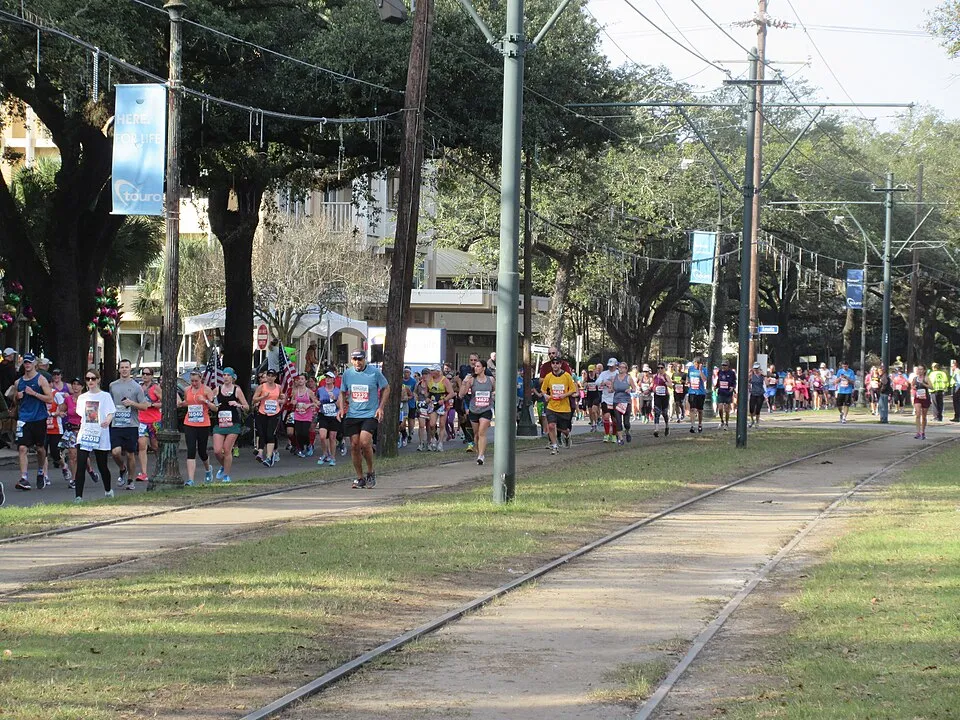
Running the New Orleans Marathon feels deceptively easy at first, which is both its charm and its trap. The course is essentially flat, hovering just above sea level with barely any elevation to work with, so your legs feel light and your pace stays honest for the opening miles. What hits you instead is the humidity and heat of November in Louisiana, which most runners underestimate. Even in late fall, the air is thick and wet, and you'll notice your breathing feels heavier than the lack of hills would suggest. The streets themselves are a mix of smooth asphalt and older paved roads that have settled unevenly over decades, so you're constantly making micro-adjustments to your stride. Around miles six through ten, as you loop through the Bywater and Marigny neighborhoods, the character of the run shifts. You're running past shotgun houses painted in faded pastels, through streets that smell like beignet powder and stale beer from the bars still cleaning up from the night before. Live oak trees with their thick, spreading branches create patches of shade that offer real relief, and locals occasionally cheer from their porches. The crowds are sporadic but genuine, nothing like the wall of spectators you'd find in bigger marathons. By the halfway point, the flat terrain starts to feel like both a blessing and a mental challenge. Your legs aren't being pounded by descents, but the monotony of not changing elevation works differently on your mind than a hilly course would. You enter the French Quarter somewhere around mile thirteen or fourteen, where the narrow streets and crowds create a sensory overload that can either energize or overwhelm you depending on your state. The tourist energy is thick, and you're weaving past people who aren't entirely aware a marathon is happening. Miles eighteen through twenty-two are often the mental grind of New Orleans Marathon.
Difficulty Calculator
h
:m
:s
Adjusted Time
3:54:52
Time difference: -5.1 minutes compared to a flat, road, temperate course.
Course Details
Elevation Gain45m
Elevation High5m
Elevation Low0m
How hard is New Orleans Marathon?
Moderateharder than 16% of marathons
Flattest / easiestHardest
On our difficulty model, New Orleans Marathon plays about even with an average road marathon for a 3:30 runner. It ranks #968 hardest of 1151 marathons we analyse, and #464 of 576 in United States of America. Use the calculator above to see the exact adjusted time for your own goal pace.
What will you run at New Orleans Marathon?
Estimated finish times on this course versus the same effort on an average road marathon, based on its elevation, surface, and expected race-day temperature.
| Average-course time | On New Orleans Marathon | Difference |
|---|---|---|
| 3:00:00 | 2:55:24 | −04:36 |
| 3:30:00 | 3:25:09 | −04:51 |
| 4:00:00 | 3:54:52 | −05:08 |
| 4:30:00 | 4:24:31 | −05:29 |
| 5:00:00 | 4:54:07 | −05:53 |
| 5:30:00 | 5:23:41 | −06:19 |
| 6:00:00 | 5:53:12 | −06:48 |
Use the calculator above for your exact goal time. Want a prediction from your own training? Try the marathon time predictor.
New Orleans Marathon 2026 Course Analysis
New Orleans Marathon is a full marathon held in New Orleans, United States of America. It is scheduled for Saturday 14 November 2026. The course is run on road surface with 45m of total climbing, with its high point near 5m above sea level.
Elevation Profile
This is a very flat course, with only 45m of total climbing and little change in altitude throughout. Flat profiles let you hold an even pace from start to finish, which makes this a fast, PB-friendly race.
Surface Type: Road
New Orleans Marathon is run on road surfaces, which provide the fastest and most predictable conditions for racing. Road courses allow for consistent pacing and are typically the best choice for a personal best.
Looking for an easier marathon or a tougher challenge? You can also compare New Orleans Marathon against other marathons to find the right race for your goals.
Marathons of similar difficulty
If New Orleans Marathon fits your goal, these courses play out about the same on our difficulty model.
Other Marathons in United States of America
Garmin Kansas City Marathon
Kansas City, United States of America
Road308m gainOct 2026
Blue Sky Marathon
Fort Collins, United States of America
Road1064m gainOct 2026
Mankato Marathon
Mankato, United States of America
Trail277m gainOct 2026
Jackson Hole Marathon
Jackson, United States of America
Trail173m gainOct 2026
Cannonball Marathon
Greensboro, United States of America
Road0m gainOct 2026
Baltimore Marathon
Baltimore, United States of America
Road298m gainOct 2026