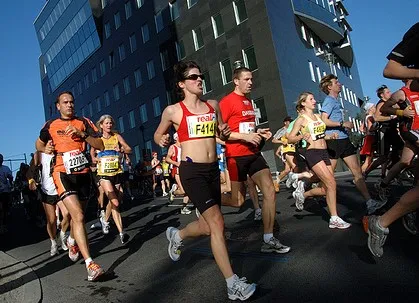
New York City Marathon
United States of America · Sunday 1 November 2026
The New York City Marathon is a major annual long-distance running event that began in 1970 with 127 participants completing laps around Central Park, organized by Fred Lebow and Vince Chiappetta. The race expanded dramatically in 1976 to celebrate the U.S. bicentennial by including a route that traversed all five boroughs of New York City a feature that quickly became a trademark and ongoing tradition.
Difficulty Calculator
h
:m
:s
Adjusted Time
4:00:43
Time difference: +0.7 minutes compared to a flat, road, temperate course.
Course Details
Elevation Gain247m
Elevation High79m
Elevation Low2m
Weather Forecast
High13°C
Low4°C
Chance of Rain2%
How hard is New York City Marathon?
Moderateharder than 39% of marathons
Flattest / easiestHardest
On our difficulty model, New York City Marathon plays about 4 minutes slower than an average road marathon for a 3:30 runner. It ranks #703 hardest of 1151 marathons we analyse, and #366 of 576 in United States of America. Use the calculator above to see the exact adjusted time for your own goal pace.
What will you run at New York City Marathon?
Estimated finish times on this course versus the same effort on an average road marathon, based on its elevation, surface, and expected race-day temperature.
| Average-course time | On New York City Marathon | Difference |
|---|---|---|
| 3:00:00 | 2:57:59 | −02:01 |
| 3:30:00 | 3:29:16 | −00:44 |
| 4:00:00 | 4:00:43 | +00:43 |
| 4:30:00 | 4:32:19 | +02:19 |
| 5:00:00 | 5:04:02 | +04:02 |
| 5:30:00 | 5:35:53 | +05:53 |
| 6:00:00 | 6:07:51 | +07:51 |
Use the calculator above for your exact goal time. Want a prediction from your own training? Try the marathon time predictor.
New York City Marathon 2026 Course Analysis
New York City Marathon is a full marathon held in United States of America. It is scheduled for Sunday 1 November 2026. The course is run on road surface with 247m of total climbing, with its high point near 79m above sea level. For registration and full race details, visit the official New York City Marathon website.
Elevation Profile
With 247m of total climbing, this is a gently undulating course. The elevation changes are manageable for most runners and shouldn't greatly affect your pacing.
Expected Race Day Weather
Based on historical weather data for November, the expected race day conditions are as follows. Near-ideal running temperatures are expected, ranging from 4°C to 13°C. This temperature range is widely considered optimal for marathon performance, allowing efficient heat dissipation without cold-related issues. There is a low chance of rain (2%), so dry conditions are likely.
Surface Type: Road
New York City Marathon is run on road surfaces, which provide the fastest and most predictable conditions for racing. Road courses allow for consistent pacing and are typically the best choice for a personal best.
Looking for an easier marathon or a tougher challenge? You can also compare New York City Marathon against other marathons to find the right race for your goals.
Marathons of similar difficulty
If New York City Marathon fits your goal, these courses play out about the same on our difficulty model.
Other Marathons in United States of America
Run Crazy Horse
Crazy Horse Memorial, United States of America
Road216m gainOct 2026
Whiskey Row Marathon
Prescott, United States of America
Road0m gainOct 2026
Hartford Marathon
Hartford, United States of America
Trail230m gainOct 2026
Rogue Marathon
Medford, United States of America
Road168m gainOct 2026
Holloman Ace of Races Marathon
Alamogordo, United States of America
Road104m gainOct 2026
Des Plaines River Trail Marathon
Libertyville, United States of America
Trail144m gainOct 2026