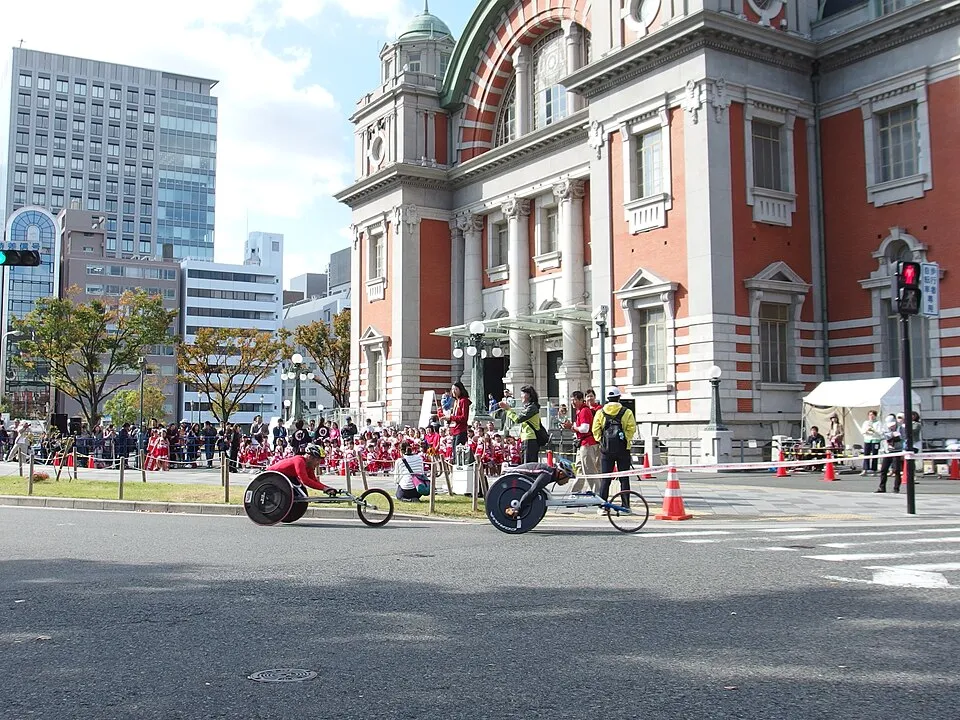
Osaka Women's Marathon
Osaka, Japan · Tuesday 26 January 2027
Running through Osaka in late January, you'll find yourself on a trail course that feels deceptively gentle. The terrain is mostly flat with only subtle rolling sections, which sounds forgiving until you realize you're running 42 kilometers and every small incline compounds over the distance. The elevation stays low, barely climbing above fifteen meters, so there are no dramatic hills to dread, but also no real descents to give your legs a break. What strikes many runners is how the flatness can feel monotonous on the mind even as it demands steady effort from the legs. You'll be navigating urban and semi-urban areas of Osaka, where the landscape changes from wider, more open stretches to narrower sections hemmed in by buildings and infrastructure. The winter weather in Osaka means you're running in cool conditions, which at least helps with pacing, though the trail surface requires attention to foot placement in ways that road marathons don't. The real character of this course comes from its consistency rather than drama. You won't face the mental relief of big downhills or the adrenaline spike of steep climbs. Instead, you run steady for hours, which demands a different kind of mental fortitude. The trail surface means your feet and joints absorb impact differently than on asphalt, and by kilometer thirty, you'll feel that accumulated jarring in ways a road race might not produce. Running through Osaka in January, you're also contending with the rhythm of a Japanese city: organized, efficient, but offering little in the way of natural scenery or escape. This is a marathon that rewards even pacing and mental toughness more than it rewards speed or power, and runners who thrive here are typically those comfortable with steady grinding rather than dramatic surges.
Difficulty Calculator
h
:m
:s
Adjusted Time
3:54:37
Time difference: -5.4 minutes compared to a flat, road, temperate course.
Course Details
Elevation Gain40m
Elevation High15m
Elevation Low3m
How hard is Osaka Women's Marathon?
Easyharder than 15% of marathons
Flattest / easiestHardest
On our difficulty model, Osaka Women's Marathon plays about even with an average road marathon for a 3:30 runner. It ranks #984 hardest of 1151 marathons we analyse, and #12 of 15 in Japan. Use the calculator above to see the exact adjusted time for your own goal pace.
What will you run at Osaka Women's Marathon?
Estimated finish times on this course versus the same effort on an average road marathon, based on its elevation, surface, and expected race-day temperature.
| Average-course time | On Osaka Women's Marathon | Difference |
|---|---|---|
| 3:00:00 | 2:55:16 | −04:44 |
| 3:30:00 | 3:24:58 | −05:02 |
| 4:00:00 | 3:54:37 | −05:23 |
| 4:30:00 | 4:24:12 | −05:48 |
| 5:00:00 | 4:53:44 | −06:16 |
| 5:30:00 | 5:23:13 | −06:47 |
| 6:00:00 | 5:52:39 | −07:21 |
Use the calculator above for your exact goal time. Want a prediction from your own training? Try the marathon time predictor.
Osaka Women's Marathon 2027 Course Analysis
Osaka Women's Marathon is a full marathon held in Osaka, Japan. It is scheduled for Tuesday 26 January 2027. The course is run on road surface with 40m of total climbing, with its high point near 15m above sea level. For registration and full race details, visit the official Osaka Women's Marathon website.
Elevation Profile
This is a very flat course, with only 40m of total climbing and little change in altitude throughout. Flat profiles let you hold an even pace from start to finish, which makes this a fast, PB-friendly race.
Surface Type: Road
Osaka Women's Marathon is run on road surfaces, which provide the fastest and most predictable conditions for racing. Road courses allow for consistent pacing and are typically the best choice for a personal best.
Looking for an easier marathon or a tougher challenge? You can also compare Osaka Women's Marathon against other marathons to find the right race for your goals.
Marathons of similar difficulty
If Osaka Women's Marathon fits your goal, these courses play out about the same on our difficulty model.
Other Marathons in Japan
Kanazawa Marathon
Kanazawa, Japan
Road280m gainOct 2026
Fukuoka Marathon
Fukuoka, Japan
Road420m gainNov 2026
Kobe Marathon
Kobe, Japan
Road70m gainNov 2026
Ehime Marathon
Matsuyama, Japan
Road179m gainFeb 2027
Kyoto Marathon
Kyoto, Japan
Road166m gainFeb 2027
Kitakyushu Marathon
Kitakyushu City, Japan
Road81m gainFeb 2027